Recap: Flying Fishtank #6
Inquiry, Notation, and the Theatrical "Contract"
Flying Fishtanks are the community’s quarterly online gathering. On April 19th the main focus was on Theatre, and was led by Pedro Larraya…
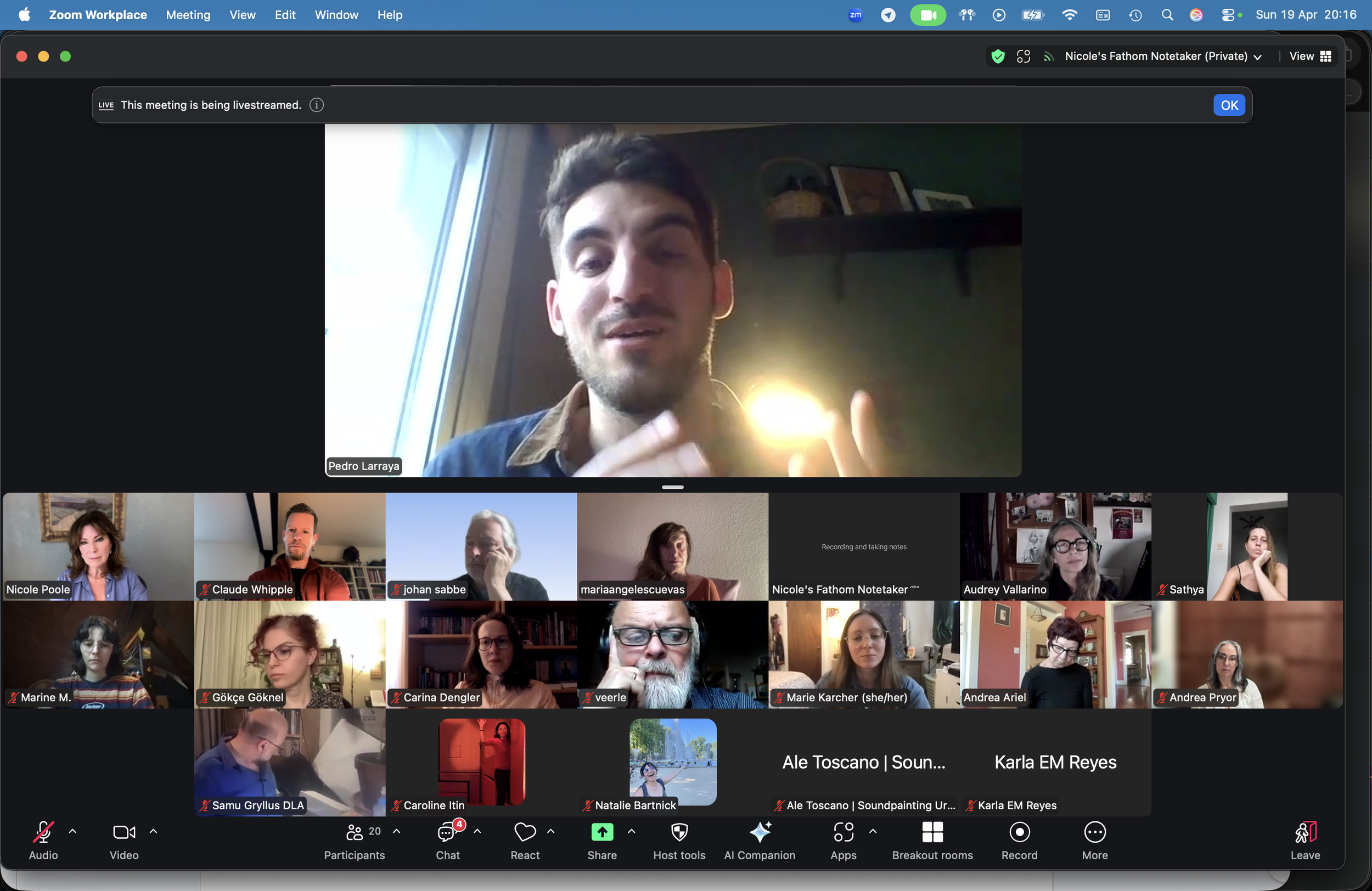
Our latest Flying Fishtank session was a testament to the global and multidisciplinary nature of our community. We explored more of the "why" and "how" of our practice on stage.
The Gathering in Numbers
We were joined by 25 practitioners connecting from 10 different countries, representing a vast range of perspectives from across the globe:
Europe: France, Spain, Germany, Belgium, Switzerland, Turkiye, and Austria/Hungary.
Americas: USA, Argentina, and Uruguay.
1. The "Reading Contract": A Lens for Interpretation
Pedro Larraya (referencing the work of Eliseo Oberon) introduced the concept of the "Reading Contract"—the invisible agreement between performers and the audience regarding how to interpret a work.
In its current state, the Soundpainting contract is heavily rooted in musical logic. This raised a vital reflection for the group: When an actor enters the Box, is the audience primarily "reading" for musical elements (rhythm, tempo, pulse) or for theatrical ones (intent, presence, narrative)? The discussion touched on the friction that occurs when non-musicians feel the need to "translate" their core professional skills into musical metaphors to fit this perceived contract.
2. Pedagogical Reflections: Revisiting the On-Ramps
Rather than advocating for a single method, the session opened up a series of reflections regarding how we introduce the language to different disciplines:
The Shared Foundation: We questioned whether a universal musical entry point (Workbook 1) is the most effective way to ensure a shared syntax across all disciplines.
Discipline-Native Initiations: We explored the idea of parallel "on-ramps" where dancers or actors might begin with foundational signs that speak directly to their "mother tongue"—such as Space, Direction, Neutral, or Intention.
Long-term Synthesis: The core inquiry remains: how do we ensure that by the time we reach Level 3, every artist is bringing their full professional depth to the ensemble, rather than just an adaptation of musical vocabulary?
3. Moving Beyond "Accessories" on Stage
Marie Karcher shared insights from the Letter of Mark Theater Ensemble, illustrating how Soundpainting can act as a generative tool during a long-term rehearsal and playwriting process.
This sparked a reflection on Theatrical Integrity: how to use theater signs to harness the core tenets of the craft—tension, emotional truth, and transformation. The challenge for the Soundpainter is to integrate the actor’s capacity for narrative and presence so they are central to the composition, rather than surface-level additions.
4. A New Tool for the Global Archive
Marine M. presented a technical update that promises to facilitate how we document our work: a new Soundpainting notation font and "Composer" tool. * The Innovation: This system uses the Private User Area of Unicode to solve formatting and layout issues that have historically made Soundpainting fonts difficult to use.
The Purpose: To create a standardized, legible way to score, archive, and share educational materials globally.
Next Steps: Marine will share a feedback form on Telegram to refine the pictogram legibility before the beta release.
Next Steps
June 28th: Sathya will lead our next discussion on "Multidisciplinary Thinking."
Bibliography: We are compiling a list of foundational theater and dance texts to help musicians understand the "native" languages of their collaborators.
Community Task: Keep an eye on the Telegram group for Marine’s notation survey.